-
IonQ Paid 3.9% in Cash for Ten Acquisitions: What the Q2 2026 10-Q Actually Says
2026. 8. 21.
목차
Between December 2024 and July 2026, IonQ bought eleven companies — ion trap chips, optical interconnects, atomic clocks, and finally an entire semiconductor foundry. Setting aside SkyWater, the last and largest, the other ten carried total consideration of roughly $2,975.70 million.
Before you read on, guess how much of that left the company as cash.
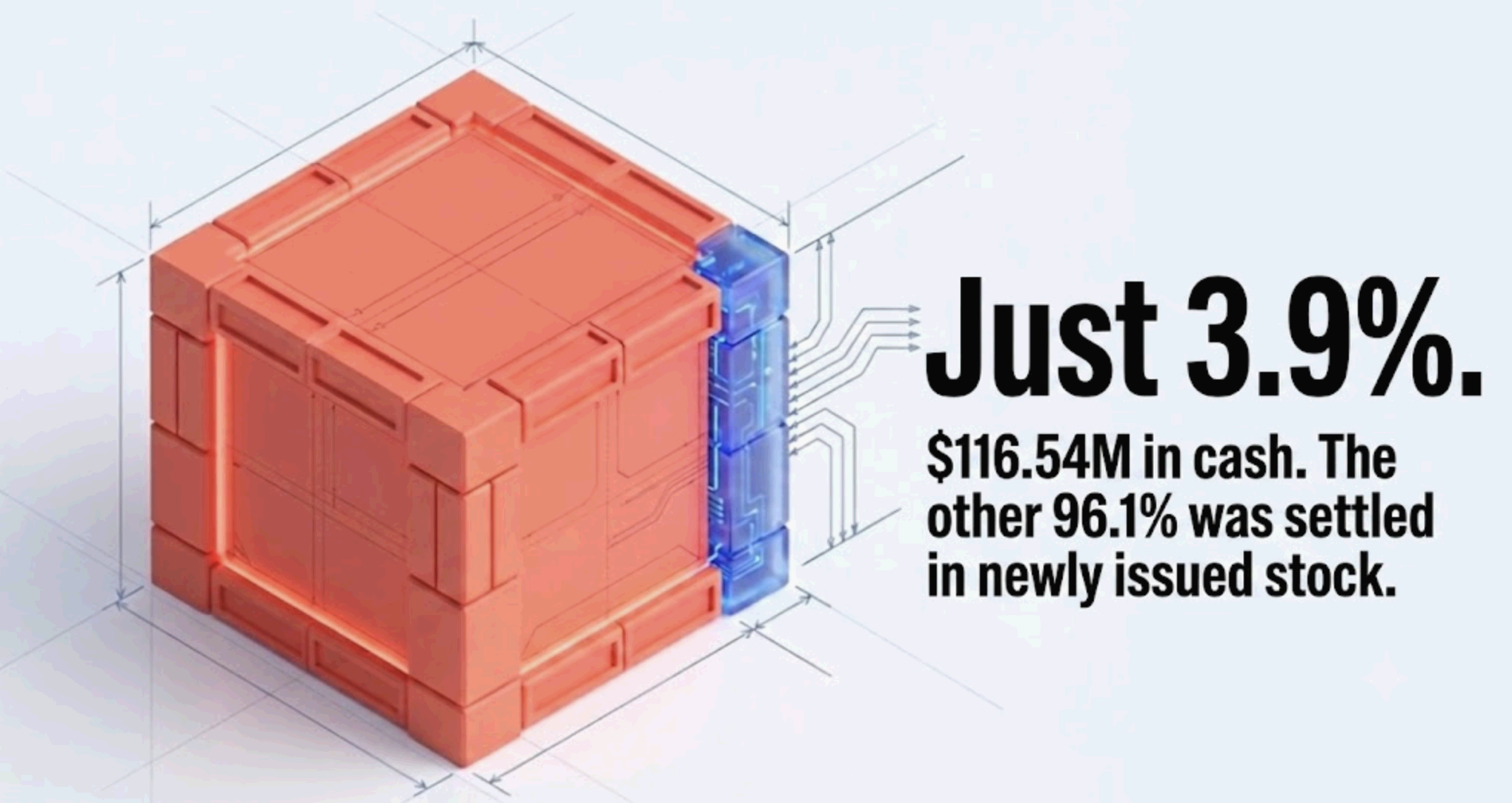
The answer is $116.54 million. 3.9 percent. The rest was settled in newly issued stock.
That is not an accusation and not a valuation call. It is an arithmetic result assembled from a public filing, and it can be checked in about ten minutes. What follows is how, and what else the check turned up.
Where the cash actually moved
Cash moved in only five of the ten deals: Qubitekk Federal ($22.07M), Capella Space ($48.35M), Skyloom Global ($36.02M), Oxford Ionics ($10.00M), and Lightsynq ($0.10M). Only the earliest, Qubitekk Federal, was paid entirely in cash. In the remaining five — id Quantique, Vector Atomic, Seed Innovations, Nexus Photonics, and one unnamed market intelligence business — no cash left the company at all.
If assembling that from footnotes feels fragile, the cash flow statement offers an independent read. It carries a line called Businesses acquired, net of cash paid and acquired. For the first half of 2026 it shows $31.79 million flowing out.
For the first half of 2025 it shows $28.67 million flowing in. Over those six months, the companies IonQ acquired arrived holding more cash than IonQ handed over for them.
Fixing the shares, not the price
The largest of the ten was Oxford Ionics, whose electronic qubit control technology sits behind IonQ's 99.99% two-qubit gate result. It accounts for 53 percent of the ten-deal total on its own.
When the deal was announced on June 9, 2025, IonQ put its value at about $1,075 million — roughly $1,065 million in stock plus $10 million in cash. The final figure booked in Note 3 is $1,589.67 million.
No one renegotiated. The agreement fixed the number of shares, calculated from the average price over the twenty trading days before closing, and that number came out to 25,372,150. But the accounting value is that share count multiplied by the closing price on the day the deal actually closed. The stock rose in between. The quantity was locked; the measured value was not.
When a share price rises between announcement and closing, the recorded cost of the deal rises with it.
Where the bill landed
Issuing 58.3 million shares in 2025 alone was not free. It shows up in two places.
Goodwill.
When you pay more than the fair value of a target's net assets, the difference is capitalized. IonQ's goodwill went from $9.9 million at the end of 2024 to $2,185.97 million as of June 30, 2026. Add $778.87 million of intangibles and the pair account for 44 percent of total assets of $6,778.59 million. Property and equipment, for comparison, stands at $144.245 million — about one twentieth of what the acquisitions put on the books.
Share count.
From 221.92 million shares outstanding at the end of 2024 to 381.04 million as of June 30, 2026, plus another 24.14 million issued for SkyWater in July.
Why no one had to be asked
One structural note for readers outside the US, because this is the part that makes eleven stock-funded deals in nineteen months mechanically possible.
IonQ is incorporated in Delaware, and its 10-K states plainly that common stockholders have no preemptive rights. Under Delaware law that right does not exist unless a charter creates one, so the board can authorize new shares without consulting existing holders — up to the 1 billion share authorization, against 381 million outstanding.
In many jurisdictions, including Korea, the default runs the other way: existing shareholders hold a statutory right to subscribe first, and issuing to outsiders requires both a charter basis and a demonstrated business purpose. Same transaction, different amount of friction. Part of this story is strategy and part of it is jurisdiction.
The one exception
SkyWater breaks the pattern. Total consideration of roughly $1.8 billion, of which $741.30 million was cash — about 41 percent, more than ten times the ratio of the preceding ten deals. Fold it in and the cash share across all eleven rises to 18 percent.
One caution about that $1.8 billion: it is the company's own approximation. IonQ disclosed in Note 21 that the allocation of assets acquired and liabilities assumed was not yet complete, so the precise purchase price is not knowable from this filing. That is why I kept it out of the 3.9 percent calculation rather than blending an estimate into a measured figure.
Check it yourself
Everything above sits in two free documents:
- Form 10-Q, quarter ended June 30, 2026 (filed August 10, 2026) — Note 3, Note 21, the cash flow statement, the balance sheet
- Form 10-K, fiscal 2025 (filed February 25, 2026) — Note 3, the statement of stockholders' equity
If your arithmetic disagrees with mine, your arithmetic is the one that matters. Tell me where it lands.
Quantum City(퀀텀시티) is a Korean-language channel covering quantum technology, where every claim is checked against the primary source — peer-reviewed papers, regulatory filings, and company disclosures — before it reaches the reader. This post condenses one section of a longer Korean analysis of IonQ's acquisition program, published on Naver Premium Content. The full piece also works through the warrants attached to the 2025 offerings — now 89 percent of total liabilities, and the reason one quarter closed $805 million in the black and the next $1,868 million in the red on almost identical operating losses.
Figures are as reported in the filings cited and current as of writing. Nothing here is investment advice. As of August 2026, the author holds no position in any company mentioned.
Quantum City
양자이론과 양자기술 관련 블로그